
Switching from a gas boiler to a ground source heat pump on the Superloop should reduce your energy bills. Once installed, you’ll likely save hundreds of pounds each year compared to running a gas boiler. Typical households should expect to save £150–£500 per year, with larger homes likely to save more. Actual savings depend on factors such as your property size, insulation and how much heating you use. This is a ~25-40% saving on your heating bill – likely the single biggest thing you can do to reduce your heating bills.
We’ve taken 3 illustrative examples to give you a better idea of what your property’s savings may look like with a Superloop heat pump.
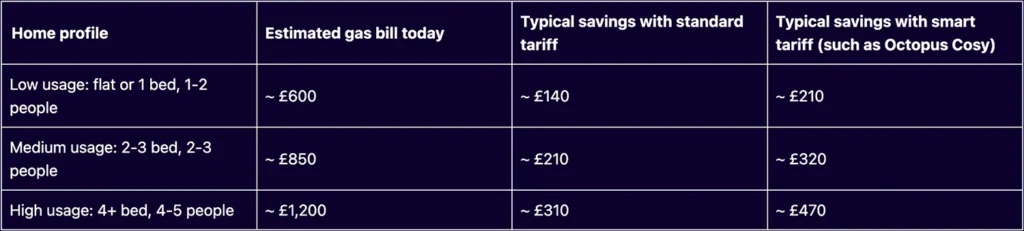
Coming soon: our savings calculator, so you can see what switching could mean for your home. In the meantime, you can explore the journey and timelines melbourn.energysuperloop.co.uk
Assumptions for the above table:
Switching from a gas boiler to the Superloop can reduce home heating emissions by almost 90%! For the average household, that’s a saving of 2 tonnes of CO₂ every year – the equivalent of taking a petrol car off the road, or avoiding up to 10,000 miles of driving.
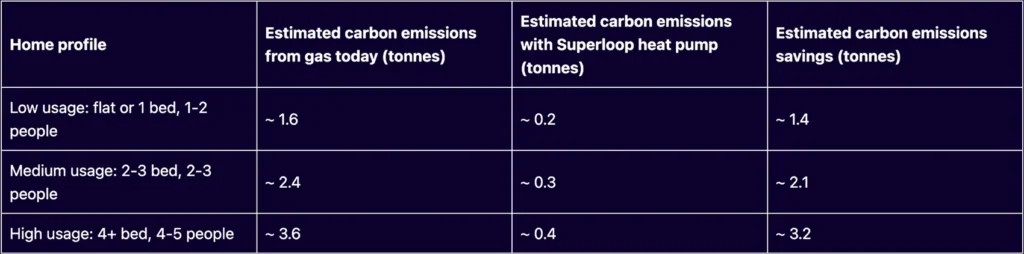
Replacing your boiler with a heat pump saves the same carbon as avoiding 3-8 return flights from London to Barcelona each year. Every household that joins Superloop makes a big difference – not just to bills, but also to the climate.
If you want to go deeper:
Assumptions/data to back this all up:
Gas boilers are a major source of both indoor and outdoor air pollution. Gas boilers and cookers pump NO2, PM2.5 and other harmful pollutants into the places our families spend the most time – kitchens, living rooms, and playing out on the street. In London, gas boilers are responsible for around 72% of NO₂ emissions, and studies link them to a higher risk of childhood asthma.
Switching to a Superloop heat pump helps cut these pollutants, making your home a cleaner and safer space.
Source: York for London and Clean Air Hub
Switching from gas to Superloop can also boost property value. Research from the WWF and Scottish Power shows that homes with a heat pump typically sell for £5,000-£8,000 more. Savills reinforces this, finding that homes with heat pumps attract a premium, as buyers increasingly value low-carbon, energy-efficient homes. This reflects not only the reduced running costs and lower carbon footprints, but also the reassurance that the property is compliant with future regulations and won’t require disruptive upgrades later.
In short, homes with heat pumps are cheaper to run, cleaner to live in and more attractive to buyers.
Sources: Savills and WWF/Scottish Power